Pyplan Application
A Pyplan application is built to solve a specific business problem by combining different capabilities of the platform. Using Pyplan, we can design applications for, among others:
- Demand planning
- Sales & Operations Planning
- Financial planning
- Pricing
- Budgeting and planning
- Forecasting
Each application brings together data, logic, and user interfaces to support a particular decision-making process.
Application Elements
A Pyplan application usually includes several core elements:
- External data sources: Components that let us import data from different systems or files.
- Data input forms: Interfaces where users can enter or adjust input data.
- Calculation and processing modules: Logic that performs computations, transformations, and other data processing tasks.
- Visualization interfaces: Dashboards, charts, and tables that present results and insights in a clear, visual way.
All these elements are organized and executed within a workspace.
Workspaces
Users with permission to create applications have access to different types of workspaces:
- Public workspace: A shared area where applications are visible and accessible to all users.
- My workspace: A personal, private area where we can create, modify, and test our own applications.
We can also access team workspaces, called Teams, to share applications and information with a restricted group of users.
Teams
Teams are configured by system administrators. Access to each Team is defined by the Department (or departments) associated with each user.
A user can belong to multiple Departments, and therefore have access to multiple Teams and their corresponding applications.
Application Manager
The Application Manager is the main interface for navigating, organizing, and managing the applications we can access. It provides tools not only to open applications and folders, but also to create, import, organize, and perform actions according to our permissions.
In the Application Manager we work on a mosaic of application cards and folders. From here we can:
- Create new applications or folders
- Import applications
- Show hidden folders (when we have permission)
- Manage our own applications and folders
- Manage Teams applications and folders
- Manage Public applications and folders
- Browse and search through all accessible applications
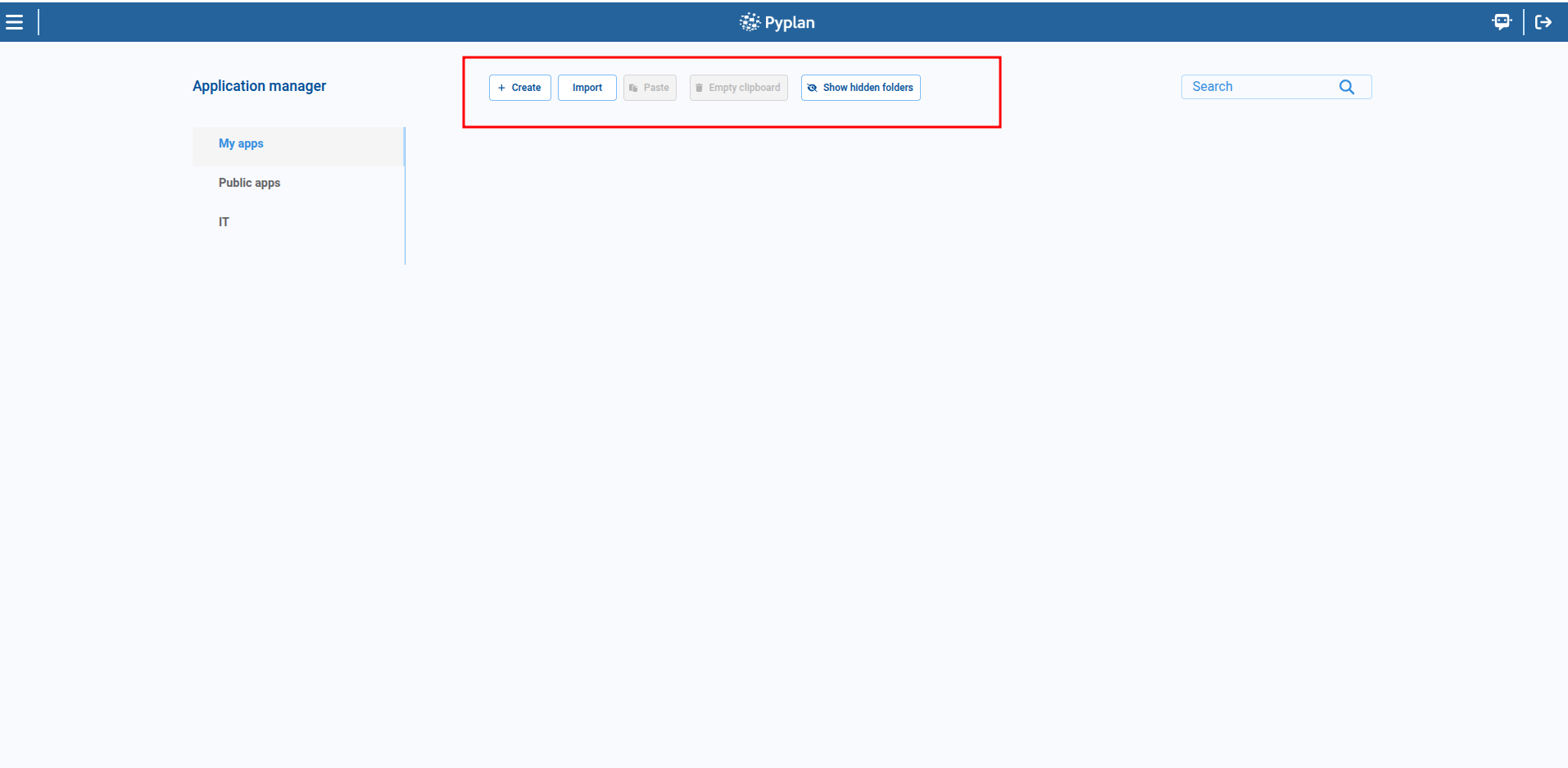
We can create both applications and application folders directly from the Application Manager.
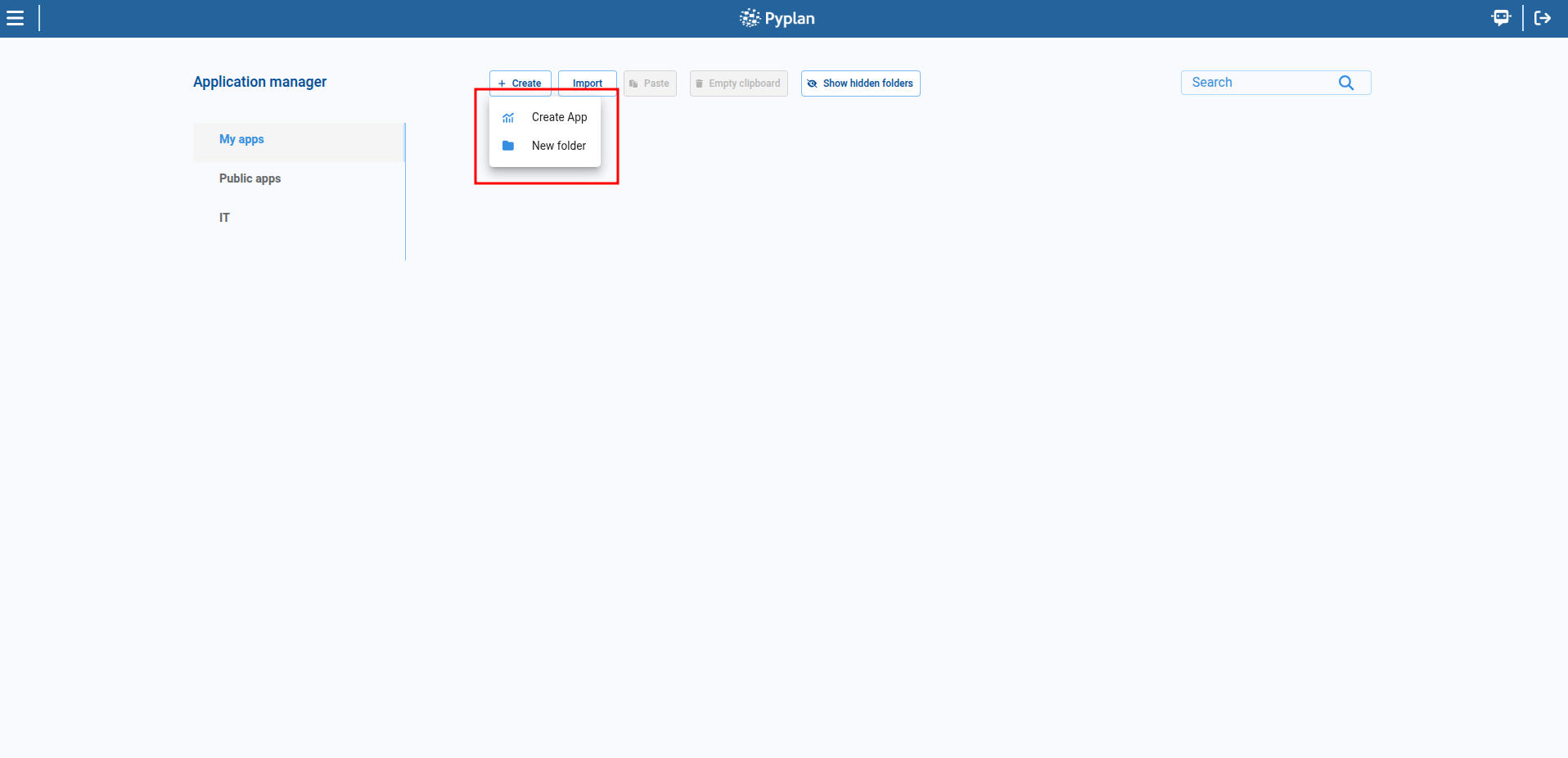
To create a new application or folder, we click the Create button and choose:
- Create App – creates a new, empty application that we can later configure and edit.
- New Folder – creates a folder that can contain multiple applications and/or subfolders.
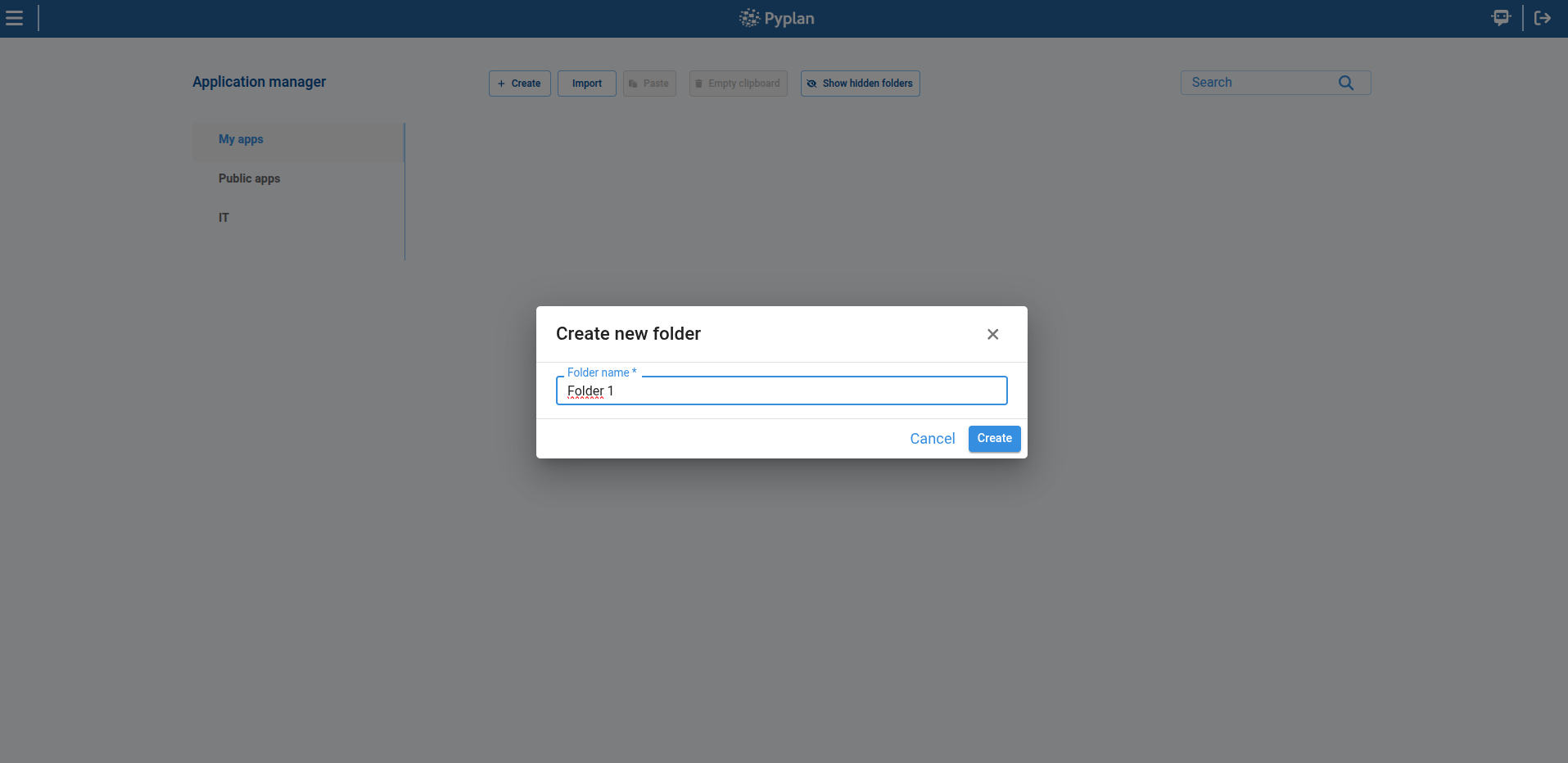
If we select New Folder, a dialog opens where we enter the folder name. The location of the new folder is determined by:
- The current tab selected (for example, My apps or Public apps), and
- The current path, if we are already inside another folder.
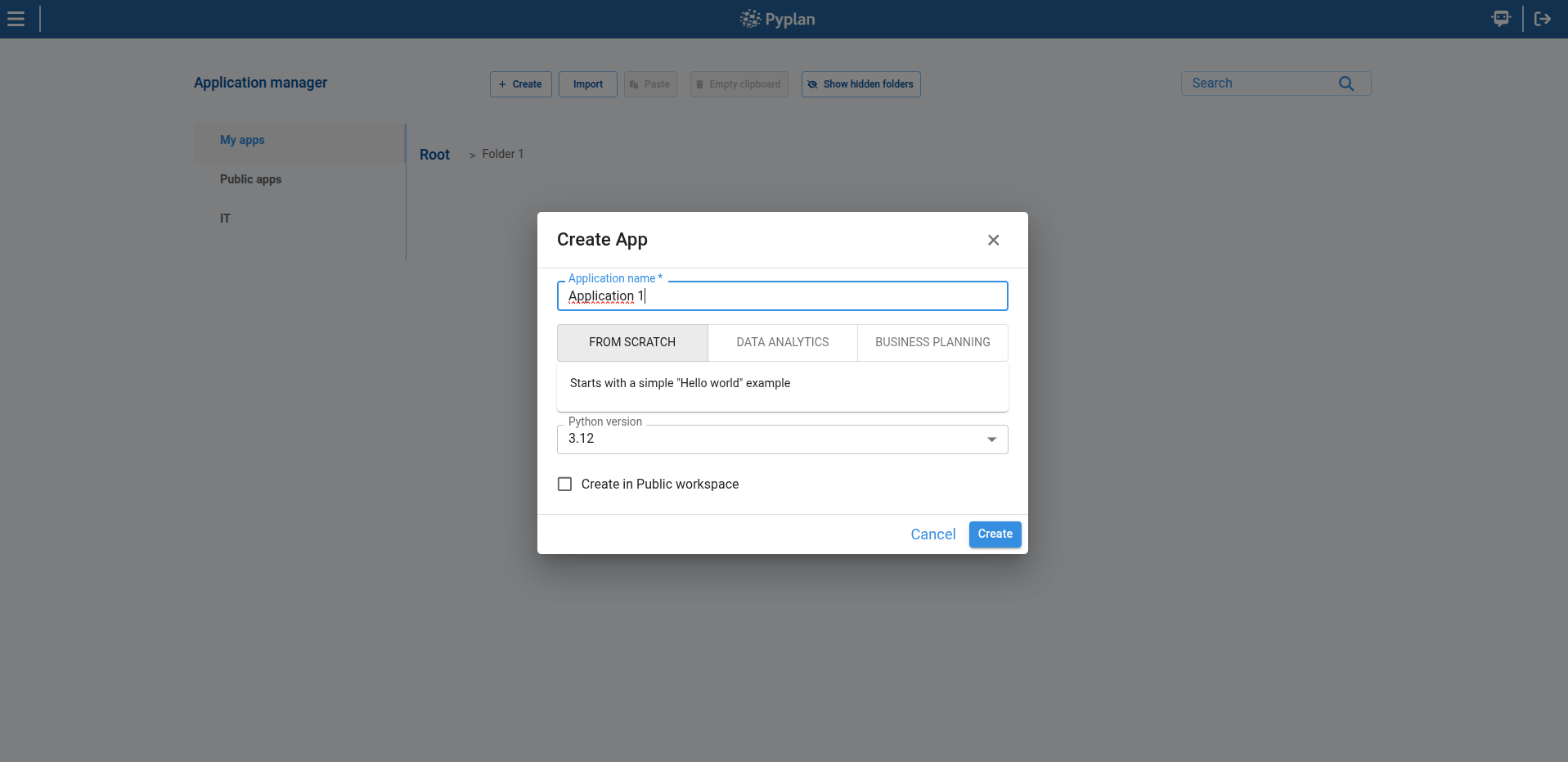
The same logic is used when we create new applications.
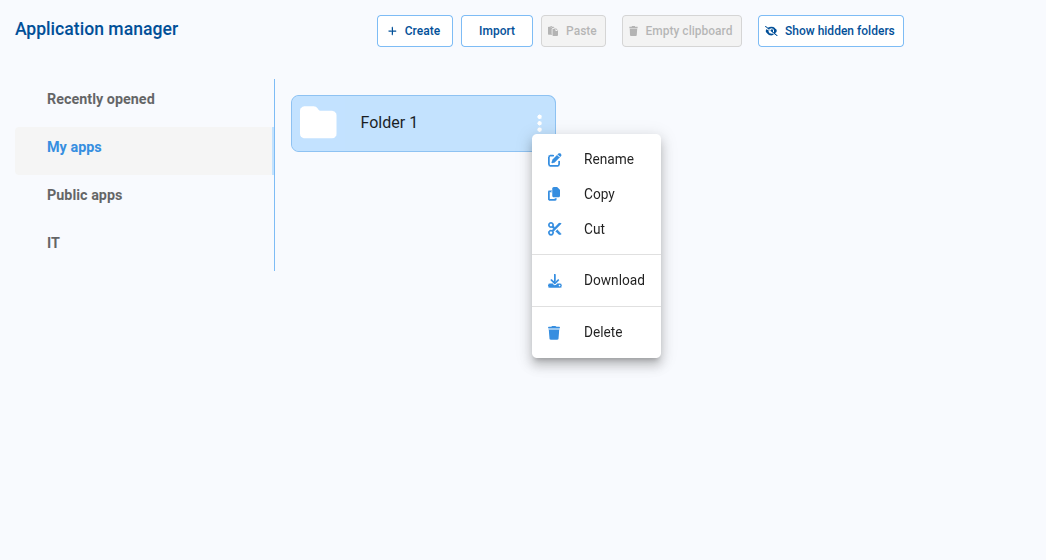
Actions on folders
For folders, we can perform the following actions:
- Rename
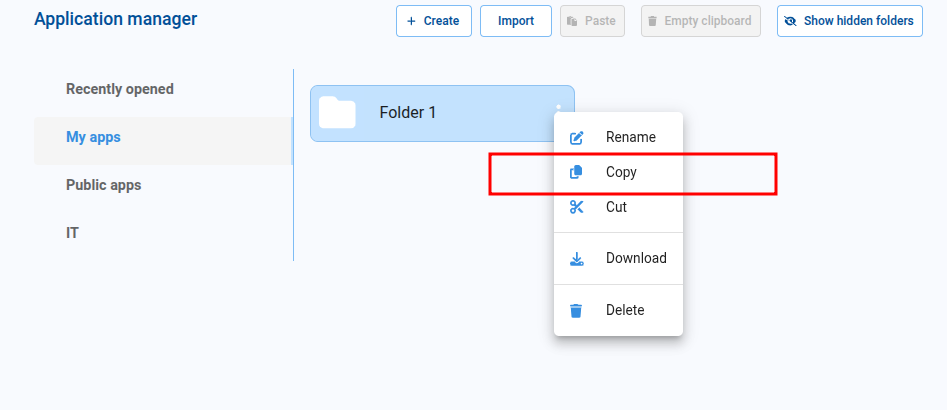
- Copy
- Cut
- Download
- Delete
Actions on applications
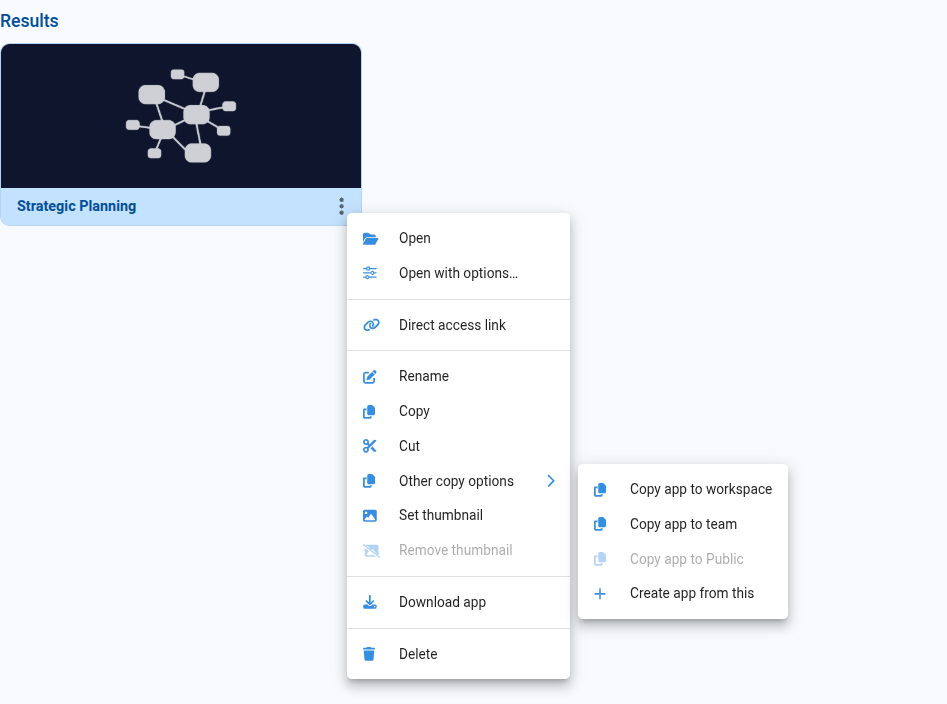
For applications, we can perform the following actions:
- Open: open the application with its default configuration. Depending on its properties, it opens the default version or asks which version to open.
- Open with options…: choose how to open the application: the version, the resources, read-only mode and a new instance. See Open with options.
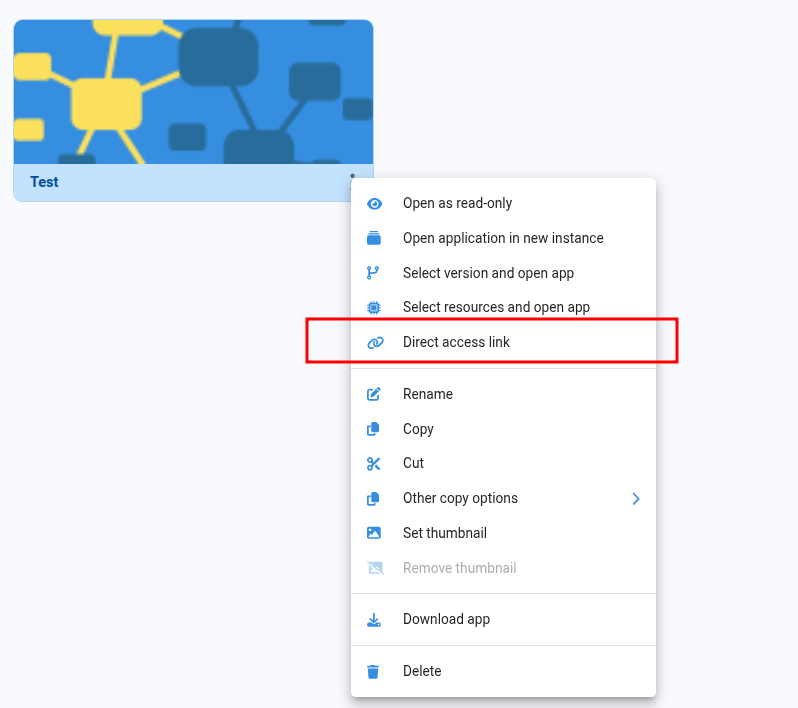
- Direct access link: generate a direct link to open the application, optionally selecting a version and enabling read-only access.
- Rename
- Copy
- Cut
- Other copy options: copy the application to another location, copy it to a Team or to Public, or create a new app from the existing one.
- Set thumbnail: assign a custom thumbnail image to the application.
- Remove thumbnail: remove the custom thumbnail and return to the default image.
- Download
- Delete
Open with options
Open with options… opens a dialog where we decide how the application opens:
- Open existing version: under Opening options we choose the Resources the instance runs with (when we have permission to select them) and whether to open it as Read-only. Then, in the versions table, we open the version we want, in the current instance or in a new one. A new instance runs separately from the open sessions and uses additional resources.
- Create new version: create a version from an existing one and open it.
- Manage versions: manage the application's versions without opening it. It is shown when we have permission to manage versions and nobody has the application open.
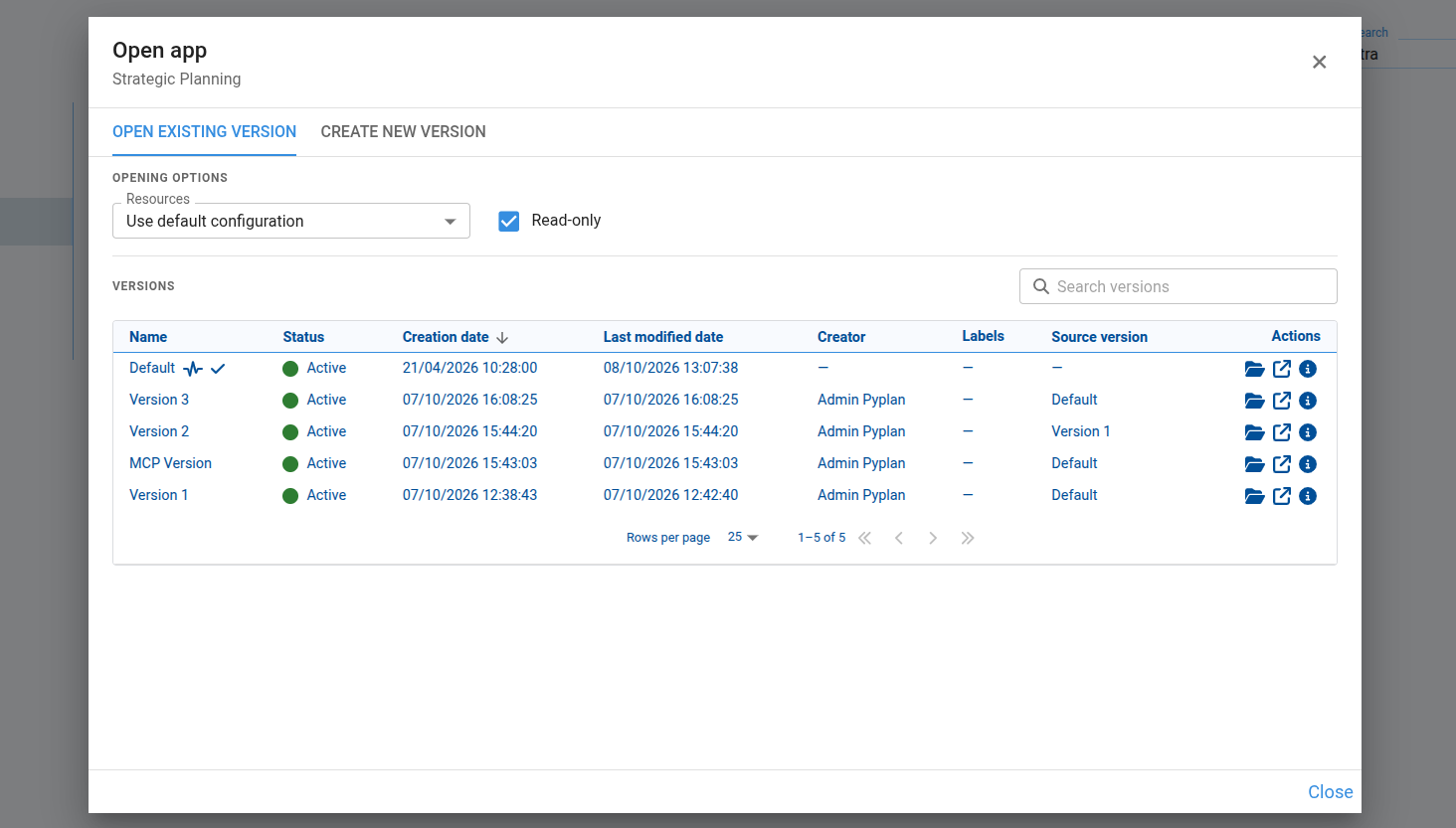
The same dialog appears when we click Open on an application configured to ask which version to open.
Direct access link
We can generate a direct access link from the application contextual menu to open a specific application directly. This option is useful when we need to share quick access to an app and, if necessary, point to a specific version.
To generate a direct access link, we follow these steps:
- In the Application Manager, we open the contextual menu of the application.
- We select the Direct access link option.
- In the dialog, we choose whether we want to use the default version or a specific version.
- If needed, we enable Open as read-only so the application opens without allowing changes. If the application is configured to open as read-only by default, this option starts enabled and the link opens the application in read-only mode even if we disable it.
- We click Generate link.
- We copy the generated URL and share it with the corresponding users.
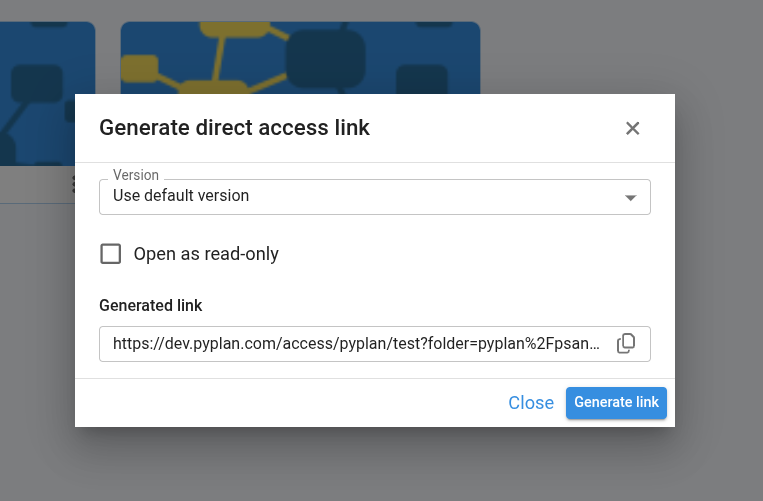
The generated link includes the selected application and can also include a specific version and the read-only mode configuration.
Move folder app example
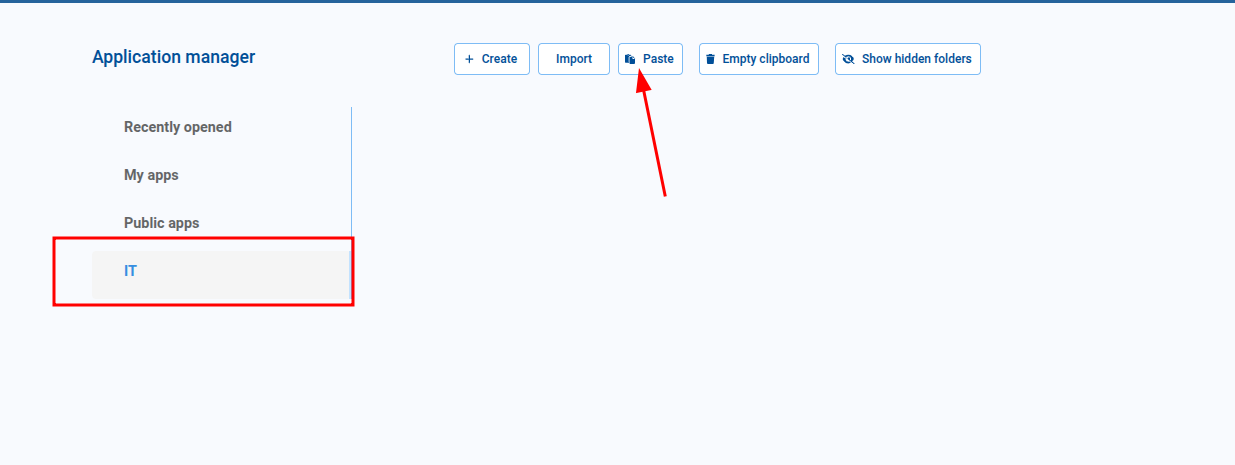
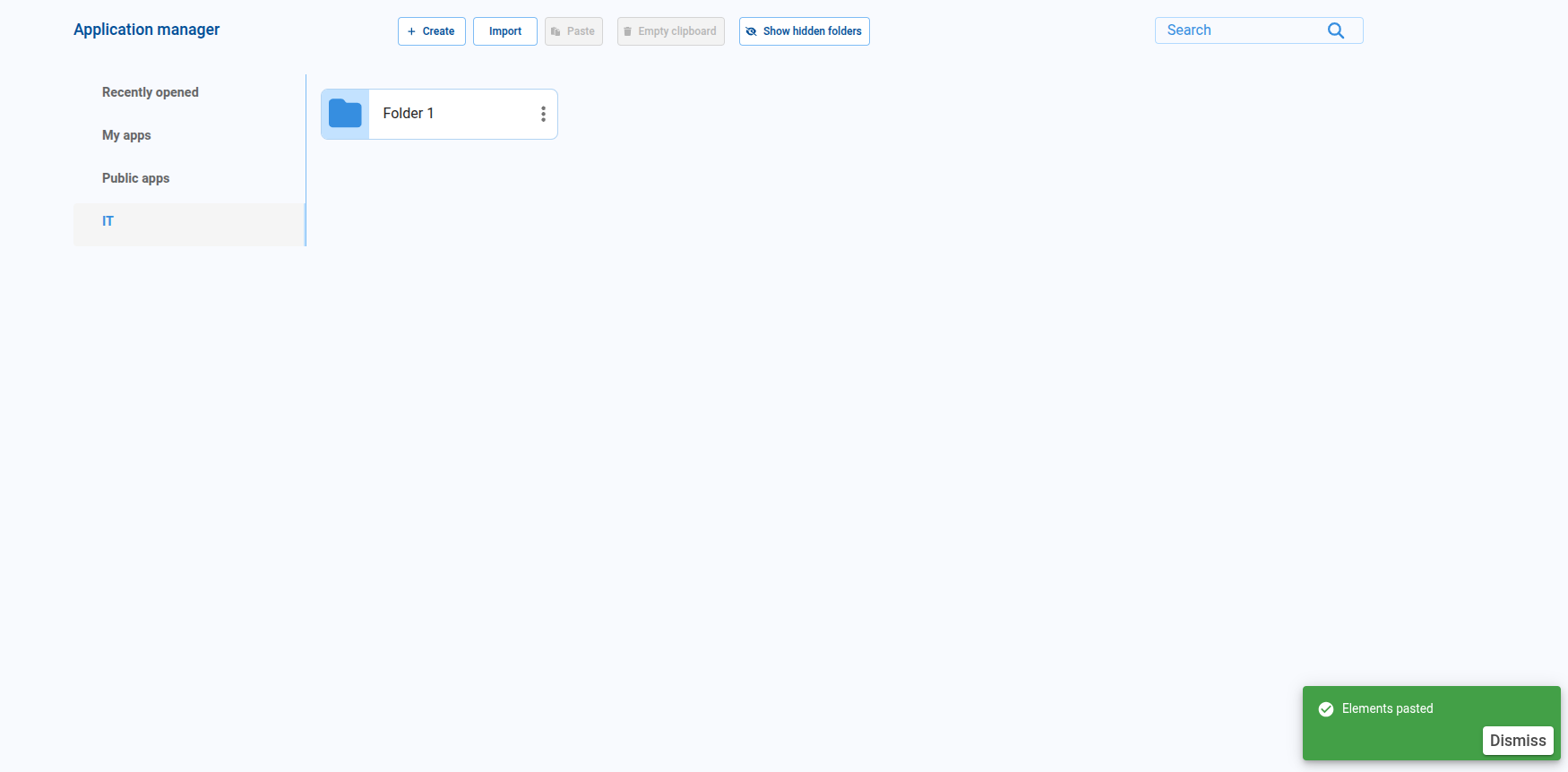
We can move applications and folders to any path where we have access. For example, we can take an application located inside a personal folder in My apps and move it to an IT Team workspace, so that members of that Team can see and use it.
Read-only and write mode
Only one session at a time can save changes to a given version of an application. The first user who opens that version, and has permission to edit it, gets write mode. Anyone who opens the same version afterwards gets read-only mode, and Pyplan shows a notification with the name of the user who is working on it.
An application also opens in read-only mode when:
- We enable Read-only in Open with options.
- We do not have permission to edit the application.
- The status of the version is not Active.
- The application belongs to a Team where our Department only has read-only access.
In read-only mode we can still navigate the application, run nodes and modify it within our session, but the Save button is disabled. Hovering over it shows why the application is read-only.
Opening an application read-only by default
When an application is used by people who only occasionally need to save, simply opening it would leave them in write mode and block other users, such as the developers maintaining the app, until they close it. For these applications we can enable Open as read-only by default in App properties > App configuration.
With this option enabled:
- Open, clicking the application card and opening it on login open it in read-only mode.
- In Open with options, the Read-only option starts enabled. Disabling it opens the chosen version in write mode, in the current instance or in a new one. This is how we open these applications in write mode.
- Direct access links and the
pp.open_appfunction always open it in read-only mode. - Reloading the application keeps the mode it was opened in.
Write mode still follows the rule of one session per version: if another user is already working on the version in write mode, disabling Read-only opens it in read-only mode anyway and shows who is using it.
Claiming write mode while the application is open
If we opened an application in read-only mode and then need to save our changes, we do not have to close it and open it again. From the top bar we click Save as and choose Claim write mode. The option is shown while the application is read-only and we have permission to edit it.
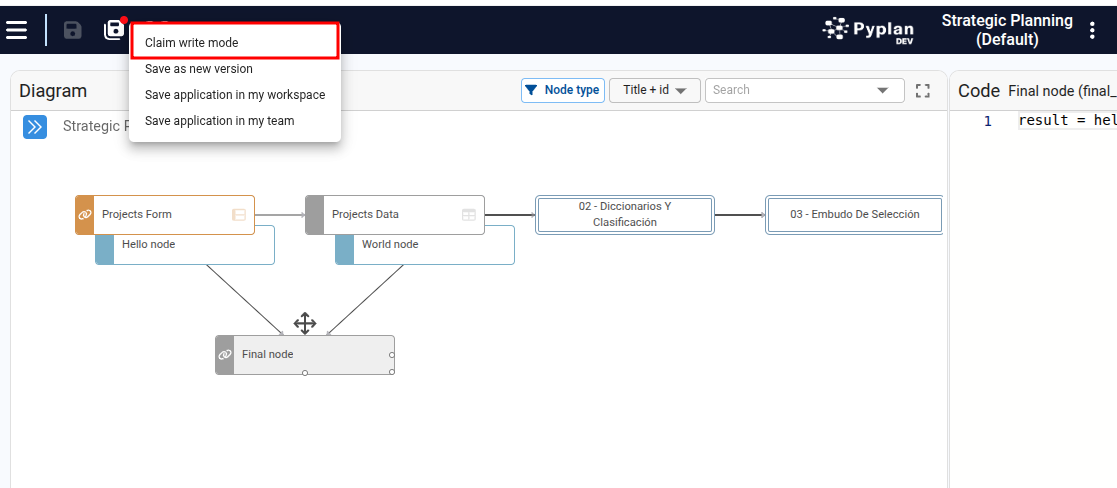
If the claim succeeds, Pyplan shows You can now save your changes, the Save button is enabled, and every change we made in the session is kept.
Pyplan refuses the claim, and the application stays in read-only mode, when:
- Another user is working on the version in write mode. The message shows who is using it. We can claim write mode again once that user closes the application.
- Someone saved the version after we opened it. Saving our session would overwrite their work, so the message shows who saved it.
- We do not have permission to edit the application, or the version is not active.
When someone saved the version after we opened it, our session no longer matches the saved application. To keep our changes, we use another Save as option, such as Save as new version. To work on the latest saved version, we reopen the application.