Azure (Azure Kubernetes Service)
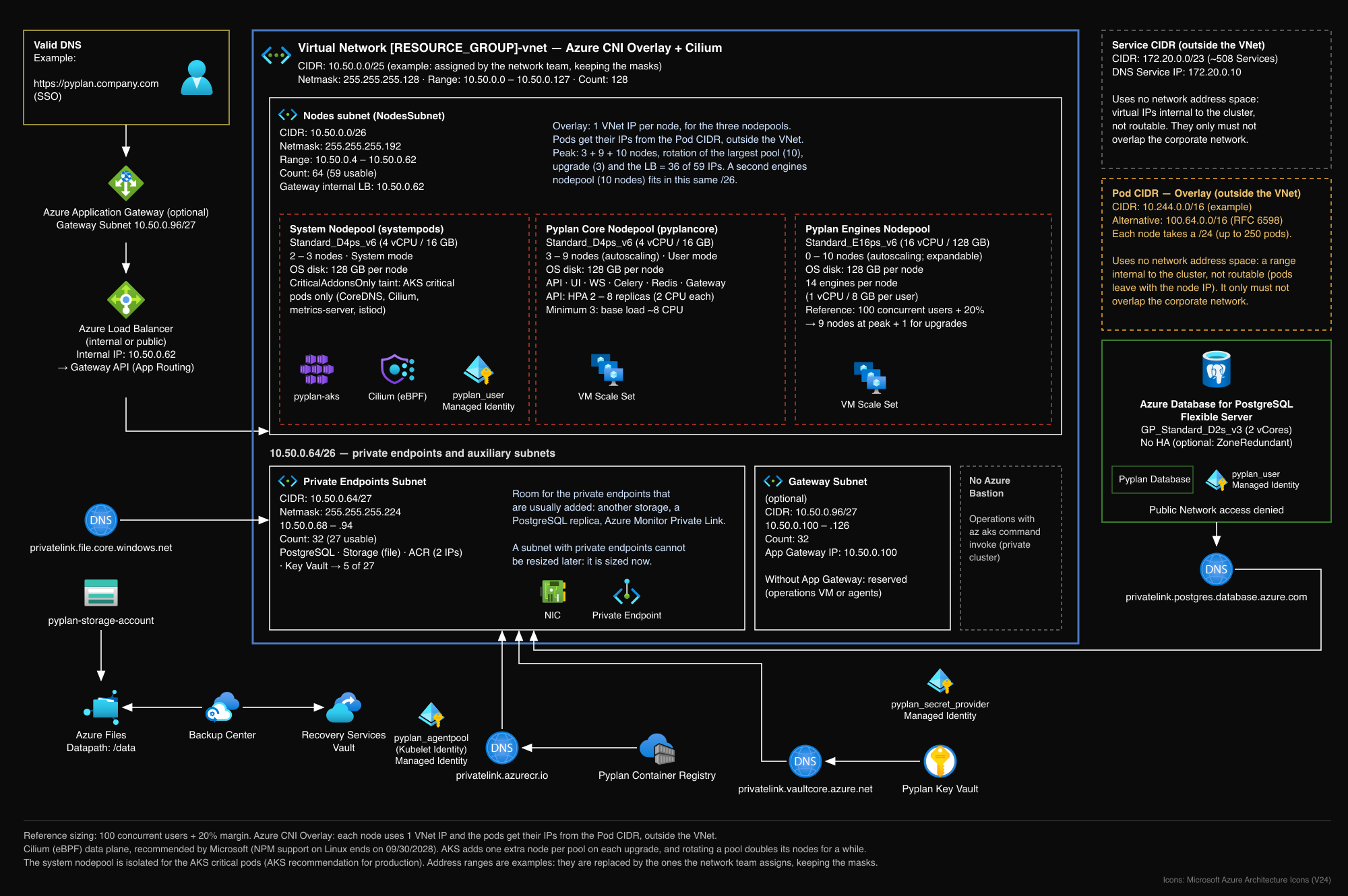
Pyplan runs on a private Azure Kubernetes Service cluster with Azure CNI Overlay and the Cilium data plane. Every data service is reached through a private endpoint, and the services authenticate with managed identities. The infrastructure is defined with Terraform, and the application is deployed with a Helm chart synchronized by Argo CD.
Reference architecture
Requirements
On top of the common requirements:
Network
Azure CNI Overlay with the Cilium data plane. The VNet only provides one address per node and per private endpoint; pods get their addresses from a Pod CIDR outside the VNet, so a /25 VNet is enough.
| Subnet | Example CIDR | Purpose |
|---|---|---|
| Cluster VNet | 10.50.0.0/25 | Address space of the cluster and its private services |
| Nodes | 10.50.0.0/26 | Nodes of the three node pools and the internal load balancer IP |
| Private endpoints | 10.50.0.64/27 | PostgreSQL, Storage Account, Container Registry and Key Vault |
| Gateway (optional) | 10.50.0.96/27 | Azure Application Gateway, if the design requires one |
| Pod CIDR (outside the VNet) | 10.244.0.0/16 | Pod addresses; not routed, but must not overlap the corporate network |
| Service CIDR (outside the VNet) | 172.20.0.0/23 | Kubernetes Service addresses; must not overlap the corporate network |
AKS cluster
- Private cluster, Standard tier, with Microsoft Entra ID integration and Azure RBAC (no local accounts).
- AKS application routing add-on with Gateway API enabled: an Istio-based gateway for ingress only, with no service mesh.
Node pools
Each node has a 128 GB OS disk.
| Node pool | VM size | Nodes | Label / taint | Runs |
|---|---|---|---|---|
| System | Standard_D4ps_v6 (4 vCPU / 16 GB) | 2 – 3 | taint CriticalAddonsOnly | AKS critical pods only |
| Pyplan Core | Standard_D4ps_v6 (4 vCPU / 16 GB) | 3 – 9 | env: Pyplan | Pyplan application pods |
| Engines | Standard_E16ps_v6 (16 vCPU / 128 GB) | 0 – 10 | env: PyplanEngines | Calculation engines |
With engines of 1 vCPU / 8 GB, a Standard_E16ps_v6 holds 14 sessions: engine nodes at peak = concurrent users × 1.2 / 14, rounded up (100 concurrent users → 9 nodes).
Database: Azure Database for PostgreSQL Flexible Server
- PostgreSQL 16, General Purpose,
GP_Standard_D2s_v3(2 vCores, 8 GB RAM) and 32 GB of storage as the minimum. - Automated backups with point-in-time restore, 30 days of retention, geo-redundant. Zone-redundant high availability (optional).
- Authentication with Microsoft Entra ID (managed identity) and password. Public network access denied; access through a private endpoint.
max_connections: 1000and all the PostgreSQL extensions enabled.
Storage: Azure Files Premium
- Premium storage account (FileStorage,
Premium_LRS) with a file share of at least 100 GB, accessed through a private endpoint. - Daily backup with Azure Backup, 30 days of retention.
- Pyplan grows the share by 20% when it passes 80% of its size, up to a configurable limit.
Security and images
- Azure Key Vault (RBAC authorization, private endpoint) for the application secrets and the TLS certificate, read by the pods through the Secrets Store CSI driver with a managed identity.
- Azure Container Registry with a private endpoint: the images are imported into it and the nodes pull them with the kubelet managed identity.
- Managed identities for Key Vault, Container Registry and PostgreSQL: no passwords or API keys between services.
Access and Internet
- CI/CD pipeline authenticated with workload identity federation (recommended); people access the cluster with their Microsoft Entra ID account. No bastion machine: ad-hoc operations use
az aks command invoke. - Permanent outbound access to the destinations AKS requires to operate (Microsoft's Outbound network and FQDN rules for AKS clusters); it can go through the corporate firewall.