Pyplan Cloud - AWS
In order to ensure a strong, secure foundation, Pyplan Cloud shares security responsibilities with an industry-leading cloud infrastructure vendor and valued partner. These cloud computing services are used by Pyplan for internal purposes as well as Pyplan clients for their own cloud deployments.
Pyplan Cloud relies on cloud infrastructure for secure physical access, redundant (fault tolerant) infrastructure and scalability.
Our cloud partner's network design and monitoring mitigate common types of network security issues such as Distributed Denial of Service (DDoS), Man in the Middle (MITM), IP Spoofing, Port Scanning or packet sniffing.
The geographical location of Pyplan Cloud's storage and infrastructure is in the United States. In case this location is not standardized by the customer (in relation to General Data Protection Regulation - GDPR), the customer may opt for an on-premise installation in a location that is in accordance with its internal rules.
A reference diagram for our Cloud deployment is shown below:
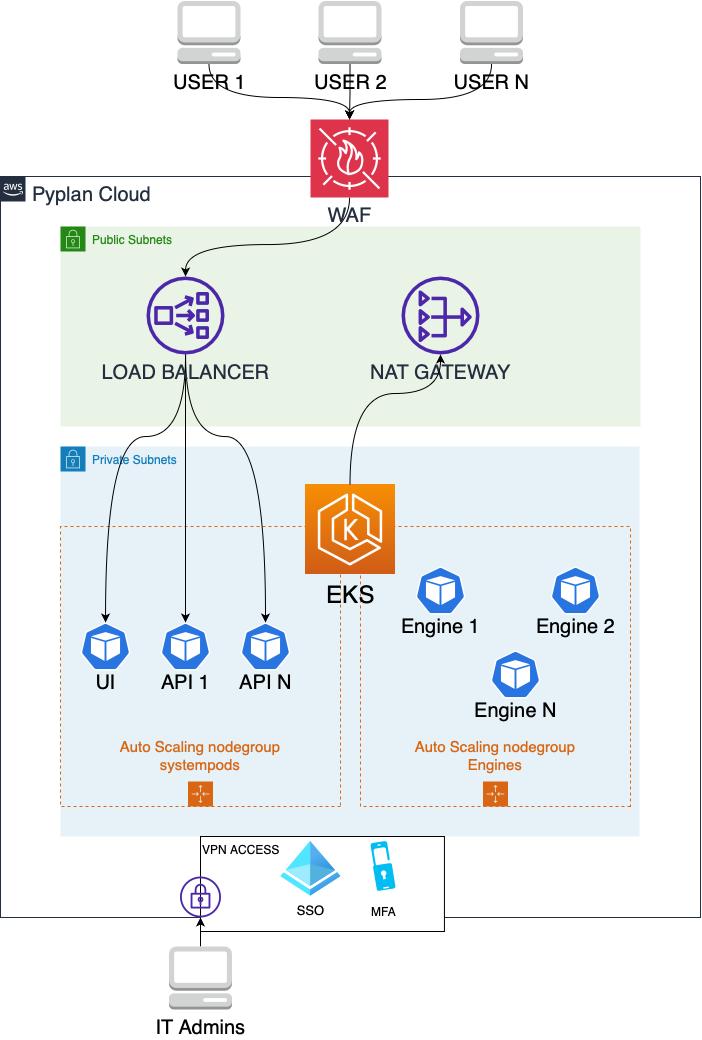
The access to infrastructure management is performed exclusively by qualified staff, implementing all the security measures offered by the supplier (i.e., VPN, Multi-factor Authentication (MFA), IP filtering, etc.).
Pyplan and Kubernetes
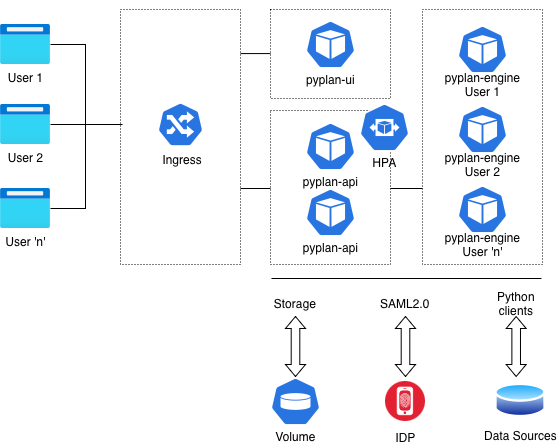
Pyplan uses Kubernetes to grant a both scalable and high-availability service. The architecture based on containers allows Pyplan to get optimal use of resources, enabling it to define how much CPU and memory grant to certain user groups. A key feature of this platform is the ability to horizontally scale up as workloads increase and scale back down as they reduce, which is used in Pyplan to ensure consistent performance for our customers regardless of the number of users on the platform. Automated monitoring and adjustment of resources allows all components of the platform to have the right resources at the right time.
A reference diagram for our Kubernetes deployment is shown below:
Some of the key technologies used in Pyplan are:
- Kubernetes: Provides automated container deployment, scaling, and management. See https://kubernetes.io/
- Redis: An in-memory data structure store used as a database, cache and message broker. See https://redis.io/
- PostgreSQL: A powerful object-relational database system used as the repository within Pyplan. See https://www.postgresql.org/
Data Management
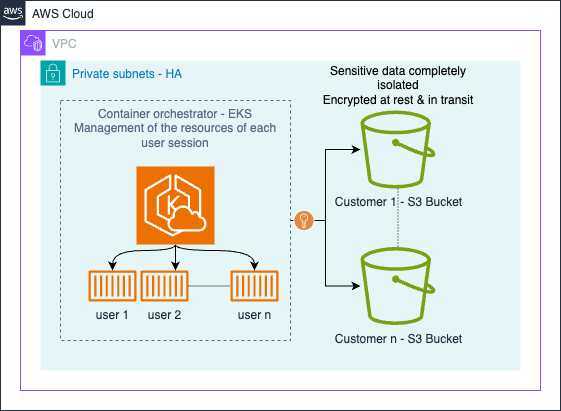
The information is fully isolated within encrypted S3 buckets (both in transit and at rest), with access strictly limited to private endpoints deployed within the same VPCs as the container orchestrators. This architecture ensures that no access is possible from the public internet.
Backup Policies
Pyplan Cloud performs daily backups. Such backup information is stored encrypted for 1 month after which it is moved to a cold storage for 5 additional months. After such period, the backup information is deleted.
Service Level Agreement (SLA)
Pyplan Cloud will use reasonable efforts to make the application available with a monthly uptime percentage of at least 97.5%.
SLA Exclusions
The Service Commitment does not apply to any unavailability or suspension of Pyplan Cloud:
- Caused by factors outside of our reasonable control, including any force majeure event or Internet access or related problems beyond the demarcation point of Pyplan Cloud
- That result from any voluntary actions or inactions from you or any third party
- That result from your equipment, software or other technology and/or third-party equipment, software or other technology (other than third-party equipment within our direct control)
Status Page
Service status of Pyplan Cloud can be found at https://status.pyplan.com.
Predictable Performance at Scale
To ensure the best possible end user experience, Pyplan is exhaustively stress tested in order to be performant and scale accordingly. Several different configurations are tested to make sure that the tenants can cope with the expected use cases and loads. Some of the parameters tested include:
- User ramp-up (number of users accessing the tenant per time unit)
- User type
- Number of concurrent users
- Number and size of apps
- Number, frequency and size of concurrent reloads
Our Web Architecture
Pyplan is accessible from any device via a web browser.
Security is the key consideration in our architecture. Authentication is through the tenant's identity provider mechanism (using SAML 2.0) or through Pyplan's own system. Session duration can be accomplished by a company-wide configuration.
As with a regular browser connection, both HTTP and WebSocket traffic to Pyplan is encrypted over Transport Level Security (TLS). For that reason, the Transmission Control Protocol (TCP) port used by Pyplan is port 443.
How Pyplan Works
Pyplan runs over a Kubernetes cluster. The containers listed below are the main structure of the application, where Kubernetes will ensure its deployment into pods or another Kubernetes resource and verify their status:
PYPLAN-UIPYPLAN-APIPYPLAN-WSPYPLAN-CELERYPYPLAN-DBPYPLAN-REDIS
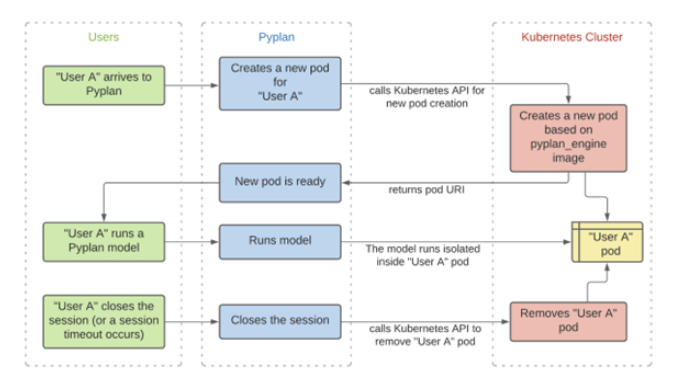
In Kubernetes, a Pod represents a set of running containers on your cluster. Every time a user opens an application, Pyplan needs to interact with the Kubernetes Application Programming Interface (API) in order to instruct Kubernetes to generate a new pod — PYPLAN-ENGINE — that will be its workspace. Furthermore, when a user logs out or a timeout occurs, Pyplan destroys the pod belonging to that user, which results in a release of resources.
Scaling
Pyplan uses Kubernetes to provide a scalable as well as a high-availability service. It uses HPA (Horizontal Pod Autoscaler) to ensure that all API requests are optimally answered. On installations in providers such as AWS, Azure, GCP, Pyplan uses node and nodepools scaling to allocate each user's computing resources.
Monitoring Tools
Supported by monitoring tools available for Kubernetes, Pyplan includes a default dashboard tool to monitor the Kubernetes cluster. Other tools such as Grafana, Prometheus, Jaeger, etc. can also be used.
These tools will only be available for qualified staff.